Before You Call It AlienBook previewReading paths

Before You Call It Alien

Choose where to go

Explore the publications, method, free assessment, and reader resources.

Get launch updates

Read from the manuscript

Four ways into the book.

Choose the reason you came. Each passage below is taken from the current prepublication edition of Before You Call It Alien.

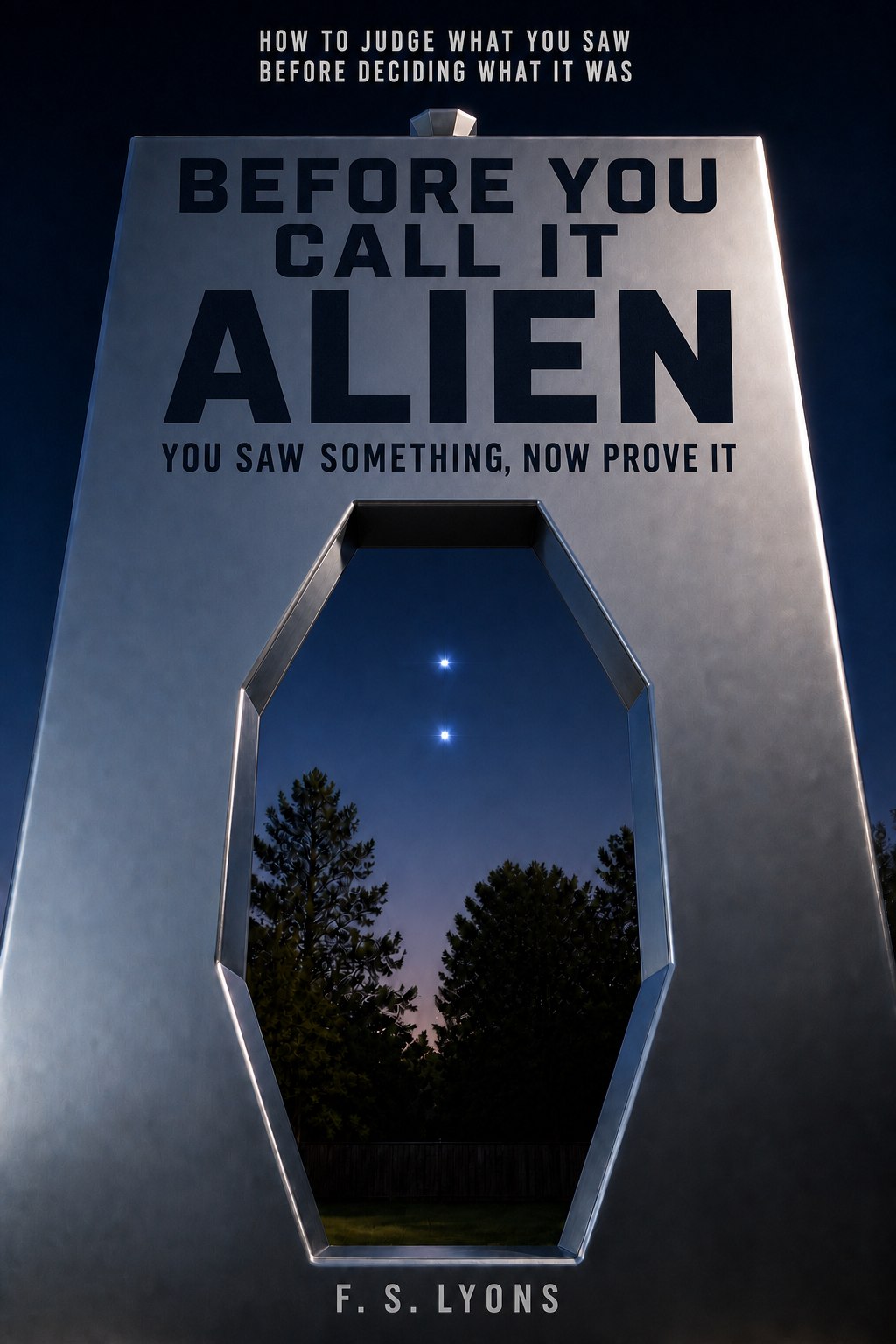
Preview editionCover of Before You Call It Alien by F. S. Lyons

Selected passages

Begin where the question is closest to yours.

Preserve first. Interpret later.

Use this guide when an event is fresh or when you need a map through an older case. It is a sequence, not a verdict: preserve first, define the question, test explanations, and state only what the record supports.

Stay safe. Do not enter restricted or private areas, and do not watch a screen while driving.

Record the exact date, local time, time zone, location, viewing direction, elevation, duration, and weather.

Describe before naming. Count lights or objects; note shape, color, brightness, sound, motion, changes, and visible landmarks.

If it is safe, capture continuous video and wide stills that include the horizon or fixed references. Avoid filters and preserve the original files.

Ask witnesses for separate accounts before group discussion. Keep identities private in review copies and use witness IDs.

From witness report to evidence file.

A UAP sighting begins as an experience. A case begins when that experience is recorded well enough for someone who was not there to study it. That transformation is one of the most important steps in the entire review.

A striking story may contain very little usable evidence. A quiet sighting recorded carefully may contain a great deal. The case reviewer’s job is to preserve what happened before memory changes, witnesses influence one another, digital files are altered, weather records vanish, and assumptions harden into facts.

A good case file should allow another case reviewer to reconstruct the event without having to trust the first case reviewer’s conclusions.

A separate sheet is enough to begin. Record the date, time and time zone, observer location and movement, viewing direction, duration, and how the event began, changed, and ended. Draw the wide scene. Label estimates and gaps.

Unknown is a status, not a cause.

A bright object crosses the evening sky. The most important fact is also the least striking: you do not yet know what you are seeing.

It does not look quite like an airplane. You cannot hear an engine. Its lights do not look familiar. For a few seconds you watch it move, trying to decide what you are looking at. A satellite? A drone? An aircraft seen from a strange angle? Something else?

At that moment, there is one answer you can give with confidence: You do not yet know. That doubt is where a UAP review begins—not with aliens or debunking, but with a sighting that has not yet been satisfactorily identified.

The most important part of that definition is not object, event, or even anomalous. It is “cannot yet.” Those words describe the present state of our knowledge. They do not tell us what the object was, where it came from, who made it, or whether anything anomalous occurred.

A light can be unidentified at 8:17 p.m. and identified as an aircraft at 8:22. The aircraft did not change. The evidence did. That distinction is the foundation of this book.

Curiosity and skepticism belong together.

UAP review is constantly pulled toward two extremes. The first says: We cannot explain it, thus it must be extraordinary. The second says: Strange things are unlikely, so there must be a common cause.

Both make the same mistake. They decide too early. A disciplined case reviewer does something harder: Follow the evidence as far as it goes. Then stop.

The result may be an aircraft. Sometimes parallax. Sometimes a balloon. Sometimes Insufficient Data. Or it may be a strong Unresolved case. All are valid outcomes.

Curiosity asks what might be possible. Skepticism asks how we know. Either one without the other decides too early. The case reviewer must be willing both to pursue an unlikely answer when evidence favors it and to release an exciting answer when evidence defeats it.

Open-mindedness does not give every hypothesis equal weight, and skepticism is more than saying no. Both require updating: identify assumptions, test alternatives, state what would change the conclusion, and follow the evidence wherever it goes.

Excerpts are from the current prepublication manuscript. Minor wording and placement may change before release. © 2026 F. S. Lyons. All rights reserved.